
Synanceia facts for kids
Quick facts for kids Synanceia |
|
|---|---|
_(6918426608).jpg) |
|
| Synanceia horrida, 1796 illustration | |
Scientific classification  |
|
| Kingdom: | Animalia |
| Phylum: | Chordata |
| Class: | Actinopterygii |
| Order: | Scorpaeniformes |
| Suborder: | Scorpaenoidei |
| Family: | Synanceiidae |
| Genus: | Synanceia Bloch and J. G. Schneider, 1801 |
| Type species | |
| Scorpaena brachion Linnaeus, 1766
|
|
| Synonyms | |
Synanceia is a famous genus of ray-finned fish. Most people call these creatures stonefish. They belong to the subfamily Synanceiinae. Scientists also place them in the family Scorpaenidae. This larger family includes scorpionfish and other close relatives. Stonefish are known as the most venomous fish in the world. Their painful stings can be very dangerous to people. These creatures live mainly in the warm waters of the Indo-Pacific. Sometimes people confuse them with the freshwater lionfish.
Contents
The History and Taxonomy of the Stonefish

German naturalists Marcus Elieser Bloch and Johann Gottlob Theaenus Schneider first described Synanceia as an official genus in 1801. They chose a fish called Scorpaena horrida as the type species. Famous scientist Carl Linnaeus had already written a species description of it in 1766. He studied a specimen from Ambon Island in Indonesia.
In biological classification, this group belongs to the tribe Synanceiini. It is one of three tribes inside the subfamily Synanceiinae. The scientific name comes from ancient Greek words. Syn means together or with. The word angeíon means a hollow cavity. This name describes the large, bumpy hollows on the fish's head.
Known Species of Stonefish
Scientists currently recognize several different species in this genus:
- Synanceia alula, named by William N. Eschmeyer and Kaza V. Rama Rao in 1973. It is also called the midget stonefish.
- Synanceia horrida, known as the estuarine stonefish.
- Synanceia nana, commonly called the Red Sea stonefish.
- Synanceia platyrhyncha, described by Dutch scientist Pieter Bleeker in 1874.
- Synanceia verrucosa, commonly called the reef stonefish.
- Synanceia quinque, identified in 2021 by Mizuki Matsunuma, B. Mabel Manjaji-Matsumoto, and Hiroyuki Motomura.
Where They Live and How They Behave
Stonefish are mostly marine creatures. A few kinds can enter rivers, but most prefer salt water. They love to rest near coral reefs in the tropical Pacific and Indian oceans.
These animals have amazing camouflage. Their rough, mottled skin looks just like a real rock or coral chunk. Because of this vernacular appearance, people call them stonefish. They lie totally still on the seabed waiting for food. This stillness helps them hide from bigger predators and sneaky prey.
Stonefish have sharp needle-like spines along their dorsal fin. These spines stand straight up whenever the fish feels scared. Special glands at the base of each spine produce strong neurotoxins. A hidden blade called a lachrymal saber can also pop out beside their eyes. Swimmers might never see the hidden fish and step on it by mistake. That heavy pressure forces the spines up and triggers a sharp sting. More stepping pressure causes more venom to enter the foot. Stonefish can also survive out of water on a beach for 24 hours.
Understanding Stonefish Venom
The venom of Synanceia contains a special protein known as verrucotoxin. This dangerous chemical affects cell activity through the Ca2+ channel. When touched, the spines release fluid that quickly causes intense pain and swelling. It can make breathing difficult, harm blood circulation, and cause muscles to freeze.
Treating Stings and Staying Safe

A stonefish sting causes serious envenomation along with a deep puncture wound. Anyone stung needs medical help right away. Luckily, doctors have reliable ways to treat the injury.
First aid starts by soaking the hurt area in hot water. The water should be heated to at least 45 °C (113 °F). The high heat breaks down the fragile proteins in the venom. This quick heat treatment gives fast relief and stops the poison from spreading. Doctors can also give special antivenom medicine in severe cases.
Stings and First Aid in Australia
Many stings occur along the sandy coasts of northern Australia and the Great Barrier Reef. Stonefish antivenom is the second most commonly used antivenom in that entire country. Doctors decide how much medicine to give based on the number of spine punctures.
Aboriginal Australians have lived alongside these creatures for thousands of years. Some groups hold traditional corroboree dances that show dancers warning others about stepping on the fish. They also developed clever cooking techniques to prepare stonefish safely without touching the venom.
Medical records show how often people encounter stonefish. Between July 1989 and June 1990, the Commonwealth Serum Laboratories counted 25 antivenom treatments. Most cases happened in sunny Queensland, while four occurred in the Northern Territory. The Queensland Poisons Information System took 14 urgent calls about stonefish during 2008. In very rare historical cases, such as one on Thursday Island in 1915 and another in Nago in Okinawa Prefecture, people suffered fatal outcomes before modern help arrived.
Stonefish in Cooking and Culture
Believe it or not, people actually eat stonefish in several parts of the world. It is considered a special delicacy across parts of Asia. People enjoy it in Japan, Hong Kong, and parts of Vietnam. It is also popular in Guangdong and Fujian within China. Many Hokkien speakers believe that eating it brings good health.
Chefs carefully cut away the dangerous dorsal fin spines before cooking. When exposed to boiling broth, the protein poison completely breaks down and becomes totally harmless. Cooks often simmer the white meat with fresh ginger to create a rich, tasty clear soup. Highly skilled sushi masters even prepare it raw as delicate sashimi. Its sweet white flesh makes it a favorite ocean dish.
Images for kids
-
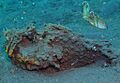
An estuarine stonefish blends in with the sandy seafloor.
-
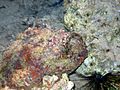
A Red Sea stonefish resting on reef rock.


See also
 In Spanish: Peces piedra para niños
